PART I — CLARITY
Chapter 3 of 10
The Timeline
If you’re reading this book, then you’ve obviously reached the point where you know you have a problem. You probably also realise that you currently don’t know how to solve that problem.
This is perhaps the most important step of all: to admit that you’re not in control of this thing. With that established, the next step is to ask, ‘What on earth is going on?’
The answer, unfortunately, isn’t entirely straightforward, but the best place to start is the beginning.
Let’s look, then, at the complete timeline of addiction (how we got here) and recovery (where we’re going).
This will be the launch pad for the work ahead.
Phases of Addiction and Recovery
As the following illustrates, addiction and recovery can be understood as a series of stages that overlap in the middle. These stages provide a broad framework: their timing and boundaries will vary, and you may recognise yourself in more than one stage.
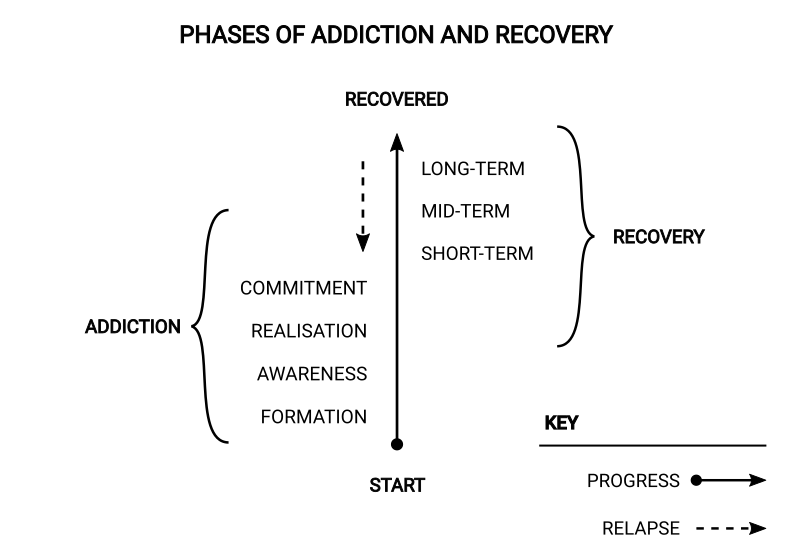
To determine exactly where you are and how you got there, we can identify and characterise these distinct stages in the overall trajectory. This is important because what you can focus on—and what will be most beneficial—changes depending on how far along you are, how far along you have been, and where you’re most likely to relapse.
Addiction Phase
The addiction phase consists of four main stages:
Formation
Formation is the stage where you first encounter alcohol, and drinking becomes embedded in your habitual behaviour. Social licensing normalises this process.
Awareness
Awareness is the stage where the negative consequences begin to seep into your consciousness. It starts to become apparent that your life is a disorganised mess. For example, you may be exhausted or overly emotional, but you don’t necessarily make the connection.
Realisation
Realisation is the stage where the negative effects are fully manifest and obviously linked to your drinking. These issues affect your health, relationships, career, and so on. You reach a tipping point and can no longer deny that you have a problem. You attempt to stop but realise you’re not in control.
Commitment
Commitment is the stage where you have accepted the reality of your situation and orient yourself towards sorting it out no matter what. If you are reading this, you’ve almost certainly reached this stage. (Well done, by the way.)
Recovery Phase
The recovery phase, in brief, consists of the following stages:
Short-Term
Short-term recovery includes the first few days and weeks after you stop drinking. Relapse happens and isn’t particularly unexpected. The primary focus here is just to stop consuming alcohol safely and prioritise your comfort. Changing too much, too quickly, will likely cause more instability and backfire.
Mid-Term
Mid-term recovery begins after a month or two of sobriety. Alcohol is out of your system and no longer consumed. The primary focus of this stage is to maintain sobriety and intensify the process of repairing your physical, mental, and emotional health. Relapse is less likely than in short-term recovery, but pitfalls are many. They should be anticipated and overcome.
Long-Term
After regaining physical health and restoring overall stability, your attention turns towards working on emotional and psychological well-being. You are making real progress towards a better life, which at this point is self-evident. Relapse becomes even less likely as you don’t want to give up everything you have achieved.
As part of long-term recovery, you begin to move towards self-actualisation: the ongoing process of becoming the person you could have been without this little detour. It means developing your abilities, living in line with your values, and realising more of your potential.
So, where are you in all of this? You’re certainly at the commitment stage and heading in the right direction.
We’ll revisit the timeline later, but for now, with a high-level understanding, we’re ready to explore the dynamics that led us here.