PART I — CLARITY
Chapter 4 of 10
Priorities
Addiction changes priorities. When your addiction is your priority, by definition, you must deprioritise something else. That something else is taking care of yourself and your basic needs.
These are, of course, the foundation of your life. Neglecting them—even slightly—affects your general well-being significantly. This needs to be recognised, stated, and rectified—no matter how obvious it may seem.
Abraham Maslow proposed the theory of a hierarchy of needs in his 1943 paper A Theory of Human Motivation.1 The theory offers a framework for what we ought to do for ourselves to achieve balance and growth. For our purposes, it can help us to prioritise what to focus on and fix before moving on to higher-order needs. As the following illustrates, the hierarchy can be split into five levels or layers.
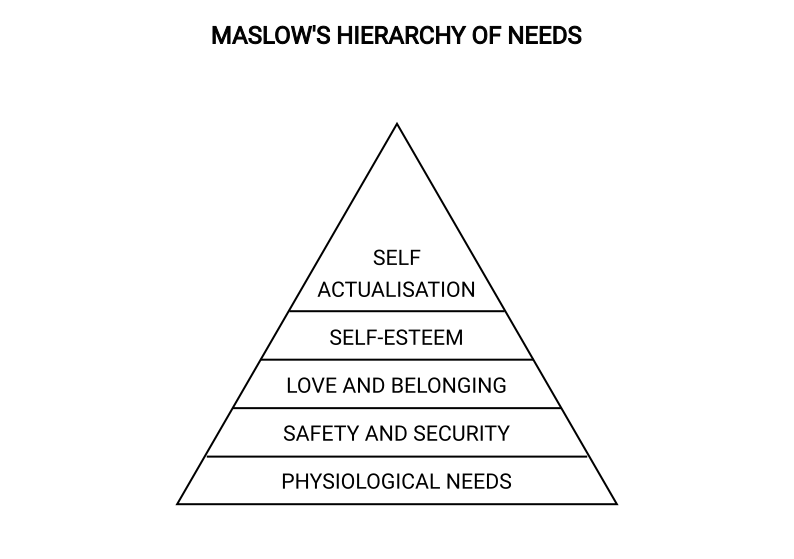
The wide base of the hierarchy, as it is usually drawn, represents broad foundational needs, including fundamental necessities for survival, such as air, water, food, and shelter. These are universal and essential for everyone. At the opposite end of the spectrum, the narrow peak represents self-actualisation: the ongoing process of developing your potential and building a fulfilling life. Meeting the needs of the lower layers provides a foundation for pursuing those at higher levels.
Ironically, drinking can begin as a way of coping with unmet needs higher up the hierarchy—a lack of belonging or self-esteem, for example. But as drinking becomes the priority, it can lead us to neglect even our most basic needs.
We can adapt this hierarchy to illustrate how alcohol changes your priorities. When you first encounter alcohol, it enters into your hierarchy somewhere in the middle. But over time, alcohol makes its way further and further down the hierarchy. As it does, layers of needs have to give way until, finally, alcohol is at the base. It’s your number one priority.
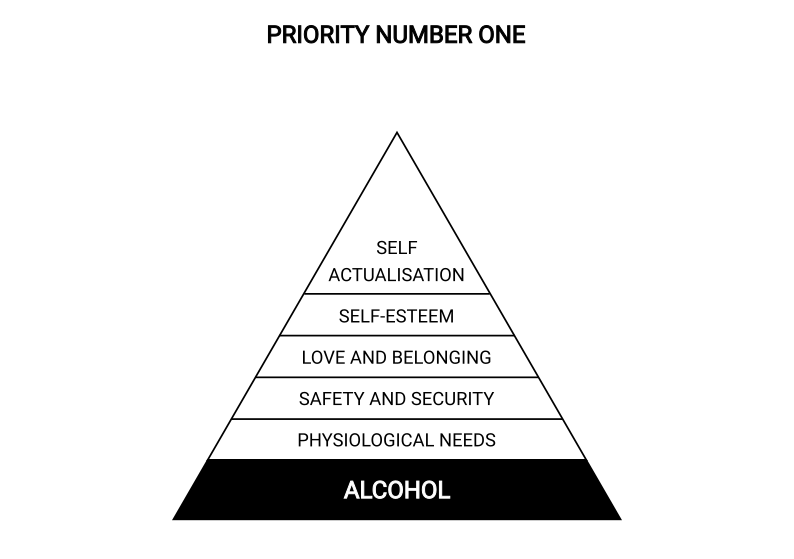
You’re never really present for anything because your mind is obsessed with your base need: alcohol. The catch is—as we shall see in the following chapters—that your need for alcohol is never met because it cannot be met. It’s an entirely open loop.
When you’re sitting eating garbage for dinner because you can’t be bothered to make anything else, that’s because your time, energy, and money were allocated to your number one priority. Whatever was left over was allocated to feeding yourself.
Unwinding all of this is not straightforward, either. In theory, you could just decide that you were going to stop prioritising alcohol, but it doesn’t work that way. You’re stuck in a Chinese finger trap—a complicated one that’s been years in the making.